显示标签为“rolling process”的博文。显示所有博文

2016年1月21日星期四

Reheating furnaces in steel Industry

In steel plants reheating furnaces are used in hot rolling mills to heat the steel stock (Billets, blooms or slabs) to temperatures of around 1200 deg C which is suitable for plastic deformation of steel and hence for rolling in the mill. 

Different type of batch and continuous furnaces are described below.
1.Batch furnace -These are the older type of furnaces which are capable of heating all grades and sizes of steel. 
2.Continuous pusher furnace– In this type of furnace cold steel stock is pushed forward with the help of pushers at the charging side. 
3.Rotary hearth furnace – A rotary hearth furnace is used for heating round billets in pipe plants and for heating short length blooms or billets in a forging plant.
4.Walking beam furnaces – Initially walking beam furnaces were designed with alloy steel walking beams which were exposed directly to the furnace heat and were also subjected to heat corrosion. 
5.Walking hearth furnaces – It is similar to the walking beam furnace when passage of steel stockl through the heating chamber is considered.
6.Roller hearth reheating furnaces – Roller hearth furnaces are used to advantage when heating very long billet, bloom or slabs in the situation where it is not practical for heating in a pusher or walking beam furnace.

Today we are talking about is continuous pusher furnace,Advantages of the pusher type furnaces are as follows:

  • High production per unit capital investments
  • High hearth area efficiency
  • Higher specific production per unit of space utilized.
  • Low maintenance cost
  • Ease of charging and discharging of material
  • Lower temperature differences between two pieces of material pushed.
  • More control of the rate of heating at all temperature levels.
  • Gradual rise in temperature permits charging of all grades of cold materials.
  • Can be built for larger length of the piece to be heated to have higher rolling mill yield
Re-heating furnace
As a professional and experience manufacturer in China, We can give turn-key service from foundation excavation, rolling line design, equipment manufacturing, installation and debugging, technician training depending on prominent capacity of designing and manufacturing and abundant practical experience of installation.

2016年1月11日星期一

Introduction to Rolling steel -Part 2

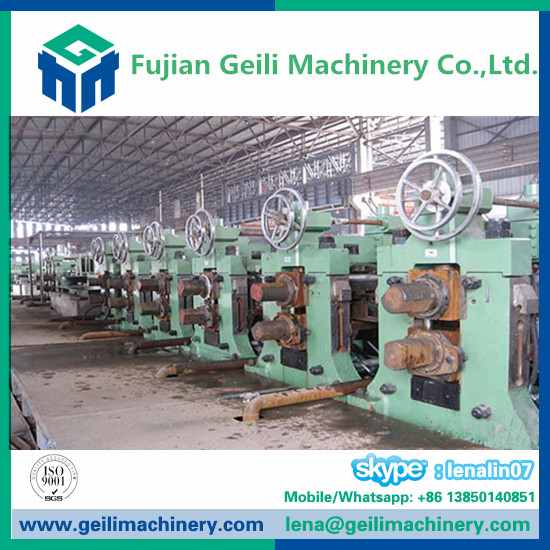
A continuous rolling mill has a series of rolling mill stands arranged in succession so as to increase productivity. The steel stock moves at different velocities at each stand in the mill.


In a broader sense, a rolling mill is an automatic system or line of roll stands along with a series of equipments that performs both rolling and auxiliary operations: transport of the original billet/bloom/slab from the stock to the heating furnaces and the mill rolls, transfer of the rolled material from one roll stand to another, turning or twisting in case of some mills, transport of the metal after rolling, cutting, cooling the rolled material on cooling bed in some mills, marking or stamping, trimming, packing, and conveyance to the stock of finished product. In some mills (e.g. hot strip mill, wire rod mill, merchant mill, and cold rolling mill), the rolled product is coiled in a coiler or a wind up reel.

There are different types of rolling mills. These are given below.
1. Continuous rolling mill
2. Reversing rolling mill
3. Transverse rolling mill – Uses circular wedge rolls. The heated bar is cropped to length and fed in transversely between rolls. Rolls revolve in one direction in the mill.
4. Shaped rolling or section rolling mill – Shaped rolling mills are bar mill, merchant mill, wire rod mill, structural mill, beam mill, and rail mill.
5. Powder rolling mill – Metal powder is introduced between the rolls and compacted into a ‘green strip’, which is subsequently sintered and subjected to further hot-working and/or cold working and annealing cycles.
6. Thin slab casting and rolling mill – This is used for the production of hot strips. Liquid steel is cast in thin slabs (thickness 50 mm to 80 mm) which are rolled in finishing mill of hot strip mill after temperature equalization in a furnace.

The above parameters may singly or jointly, in combinations of two or more, generate secondary parameters and phenomena more directly related to and commonly associated with the rolling process. Roll pressure, torque, work and power are influenced by these 
factors.

As a professional and experience manufacturer in China, We can give turn-key service from foundation excavation, rolling line design, equipment manufacturing, installation and debugging, technician training depending on prominent capacity of designing and manufacturing and abundant practical experience of installation.
Steel Rolling Production Line (turnkey service)


2015年12月30日星期三

Wire rod production line

Industrial machinery with its advancement in engineering are the tools used and applied in the industries and factories to enhance the proficiency and efficiency in terms of overall production.
It is a common fact that we find a wide variety of construction machines on every construction sites, which make the construction jobs easy, safe and quicker.

Today we are want to show you is a wire rod production line. This production line can realize a metal rolling process from billet to steel products and the feature of this wire rod production line is double way rolling.


Technical Parameter:
Finished products: Φ5.5-Φ10mm  wire rod
Steel grade: General carbon steel, high quality carbon steel, low alloy steel
Size of billet: 150x150mm( or less), 1 ton weight( or less)
Maximum rolling speed: 25m/s
Annual production capacity: 0.2-0.3 million tons with double way rolling

Main equipment:
Horizontal two high housing mill stand of 550-280 size
Disk type flying shear
Dividing shear
Water cooling box
Pinch roll
Laying head and loop cooling roller table
Coil collection station
Semi-auto tying machine...

Among these equipments, the binary mandrill coil collection station and semi-auto tying machine which we developed not only satisfies with customer's requirement, but reduces the cost of users as well.

Common wire rod production line

2015年12月24日星期四

Principles of Metal Rolling

Metal rolling is one of the most important manufacturing processes in the modern world. The large majority of all metal products produced today are subject to metal rolling at one point in their manufacture. Metal rolling is often the first step in creating raw metal forms. The ingot or continuous casting is hot rolled into a bloom or a slab, these are the basic structures for the creation of a wide range of manufactured forms. Blooms typically have a square cross section of greater than 6x6 inches. Slabs are rectangular and are usually greater than 10 inches in width and more than 1.5 inches in thickness. Rolling is most often, (particularly in the case of the conversion of an ingot or continuous casting), performed hot.

Most metal rolling operations are similar in that the work material is plastically deformed by compressive forces between two constantly spinning rolls. These forces act to reduce the thickness of the metal and affect its grain structure. The reduction in thickness can be measured by the difference in thickness before and after the reduction, this value is called the draft. In addition to reducing the thickness of the work, the rolls also act to feed the material as they spin in opposite directions to each other. Friction is therefore a necessary part of the rolling operation, but too much friction can be detrimental for a variety of reasons. It is essential that in a metal rolling process the level of friction between the rolls and work material is controlled, lubricants can help with this. A basic flat rolling operation is shown in figure:130, this manufacturing process is being used to reduce the thickness of a work piece.

During a metal rolling operation, the geometric shape of the work is changed but its volume remains essentially the same. The roll zone is the area over which the rolls act on the material, it is here that plastic deformation of the work occurs. An important factor in metal rolling is that due to the conservation of the volume of the material with the reduction in thickness, the metal exiting the roll zone will be moving faster than the metal entering the roll zone. The rolls themselves rotate at a constant speed, hence at some point in the roll zone the surface velocity of the rolls and that of the material are exactly the same. This is termed the no slip point. Before this point the rolls are moving faster than the material, after this point the material is moving faster than the rolls.

As a professional and experience manufacturer in China, We can give turn-key service from foundation excavation, rolling line design, equipment manufacturing, installation and debugging, technician training depending on prominent capacity of designing and manufacturing and abundant practical experience of installation.

Crank Flying Shear

2015年12月10日星期四

Benefits of Using steel frames

The steel industry is undoubtedly an important contributor to the economy. Most of the construction companies available in the market uses steel frame to build heavy infrastructure, and some of the main reasons owing to which steel frames is used over other types of infrastructure available in the market is its benefits which it gives to its customers.

Advantages of steel framing
Generally,building construction is finished with the help of mild steel instead of using the most powerful tool present in the market. This mild steel is very durable and strong to use, and can be used under every circumstance or for building strong infrastructure and buildings. The features of steel framing is as following:
1. Flexible, The mild steel frames can be easily bended or molded according to the comfort of the user.2. Ductility, The soft and appropriate material of the frame will not crack in extreme conditions and instead stays intact to be used for different purposes on the construction site.
3. Durable, These are very durable to use, because they can last for a longer period of time and users need not have to bear cost for replacement again and again.

Where to use steel frames?
Before the steel frames or different kinds of cladding rails are put to use, it is important to understand what their different types are and uses which can deliver the best output to the users. Following are the kind of frames which can be used;

Fujian Putian Geili Machinery manufacturing Co., Ltd was founded in 2006, the registered capital of 20,000,000 yuan. The company is located in one of the city center onn the west side of the Straits Economic Zone, Xianyou Putian. We are not only a manufacturer of steel machinery, but we have our own steel mill, which can produce deformed bar, angle bar, round steel, wire rod, steel coil, steel plate etc. If you have inquiry in these area, pls don't hesitate to contact us.

High quality steel rebar

2015年12月4日星期五

What is cooling bed

The development of steel rolling production is not only depends on improvement of speed and shortened of rolling period of mill main equipment( rolling mill) , but also so much of that depends on perfection and improvement of auxiliary equipment. the mechanization and automation of auxiliary equipment and it's productivity can direct affects the modernization development of rolling mill and improvement of productivity.

Cooling bed is an important equipment in the field of steel rolling. It used to receiving, transmissing and cooling the rolled piece. After sizing or reducing , the temperature of pipe is generally above 700 °C. It must be cooled to below 150 °C for subsequent finishing process. The pipe cooling is usually carried out on cooling bed. 
Cooling Bed for Rolling Mill


The cooling bed is consist of mechanism transmission system, water cooling system, cooling bed platform and fixed support and so on. There are many types of cooling bed, such as following:
Rack and walking beam cooling bed
Chain-type cooling bed
Roll-disc cooling bed
Section steel cooling bed

 - Have the raw material of billet or steel scraps- Want to build a steel factory- Don't know how to process or design the production line- Want to add the production line- Want to purchase the accessories
- Want to reduce the invest budgets since the high cost from European countries and long term RIO period


Walking Beam Cooling Bed


2015年11月25日星期三

Rolling mill machinery and machinery manufacturing


In metalworking, rolling is a metal forming process in which metal stock is passed through one or more pairs of rolls to reduce the thickness and to make the thickness uniform. and rolling mill is a kind of equipment which can realise a metal pressing process. It includes major equipment, auxiliary equipment, lifting and transport equipment and ancillary equipment.

The primary function of a rolling mill is to shape the metal being passed through the mill in some way, and many come with attachments and accessories which can be used for different types of tasks. Both hot and cold rolling mills are available for different metalworking applications.

A basic rolling mill is designed to produce sheet metal. The metal is passed between two tough cylinders numerous times, with the distance between the cylinders being decreased with each pass so that the metal becomes thinner and thinner.Rolling mills can also be used to produce wire. The wire may be square, octagonal, or otherwise shaped by its passage through the rolling mill.

 Short stress path rolling mill
Fujian Putian Geili Machinery manufacturing Co., Ltd was founded in 2006, the registered capital of 20,000,000 yuan. We have our own R&D department, which can develop and design products independently at the market’s price.Staffed with advanced and efficient technology and equipment, we are able to manufacture and assemble all the products independently, which ensures the good quality and JIT delivery.We engineer the design and supply of equipment for rolling mills on a world wide global basis. We have many strong partners world wide that have excellent manufacturing experience and capabilities for our products that give geili an incredible price advantage

Tandem Rolling Mills for Wire Rod